
Fungicides
Adapted from Ohio State University Extension Fact Sheet by Stephen Nameth and Jim Chatfield
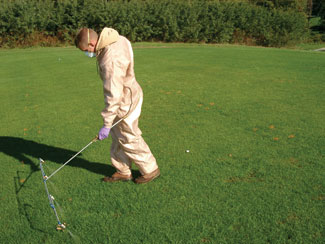
A spray method must provide the best combination of practical usefulness and good coverage. For many diseases, special attention must be given to undersurfaces of leaves, especially on the lower leaves of the plant.
Fungicides can be an important component of a disease management program. However, it is important to remember that their use should be integrated with sound cultural practices, a knowledge of pathogen and disease biology, and disease resistance whenever possible.
Fungicides are only effective when infectious plant diseases that are caused by fungi are truly the cause of the problem. In many cases, pests and diseases follow other environmental imbalances and may not be the major problem. In cases such as these, a fungicide may help but is often not the total answer. Also, it is important to remember that fungicides are only effective if several rules are followed.
Correct Diagnosis
You must be sure of what the problem is before proceeding. The most effective fungicides in use today have been developed for specific situations and specific diseases. To use these chemicals, you must spend time making a correct diagnosis.
Selecting the Proper Material
Diagnosis leads to selection of the right material to do the job. Usually, several materials are effective against the type of disease you are dealing with. For instance, triforine, sulfur or triadimefon all control powdery mildews. Before selecting any chemical, read the label. Can you carry out the instructions? Is the plant type listed on the label? If so, the chemical is registered for use on the plant, and should be effective in providing disease control if used properly. If not, it is illegal to use that particular pesticide.
A spray method must provide the best combination of practical usefulness and good coverage. For many diseases, special attention must be given to undersurfaces of leaves, especially on the lower leaves of the plant.
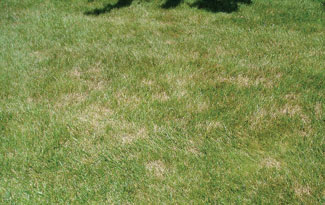
You must be sure of what the problem is before proceeding. The most effective fungicides in use today have been developed for specific situations and specific diseases, such as the Red thread pictured here. To use these chemicals, you must spend time making a correct diagnosis.
Use the Correct Method of Application
Foliar application fungicide sprays usually work in controlling infectious diseases because they act as a chemical barrier on leaf, stem or flower surfaces. When the pathogen arrives on the plant surface, it encounters this barrier and is unable to infect the plant. Effective fungicide use requires that this barrier be as complete as possible.
The completeness of the barrier depends on how well the spray spreads and sticks to the plant surfaces. For this reason, spreader-stickers or spray adjuvants can be added to many sprays. Sometimes the product label alerts the user to these problems. However, observing the spray deposit after you have finished some of the job may be the best way to decide if an adjuvant should be used. Hairy or waxy foliage is especially difficult to cover properly without a spreader-sticker.
Proper Timing of Fungicide Application
Timing refers to when and how often the spray must be applied to effectively control a disease. The first application usually is made at a time close to but before the pathogen arrives on the plant surface. This information is often provided on the pesticide label. In most situations, fungicides are not effective in controlling the disease if the pathogen has already entered (infected) the plant tissues. In many cases, specific information about the disease cycle may be needed to time the first application correctly.
After the first application is made, the pesticide barrier is established on the plant surfaces. Effective use involves keeping this barrier active and complete throughout the time that the pathogen can arrive on and infect the plant.
Modern fungicides are developed so that they do not persist in the environment for long periods of time. Rainwater, sunlight, microbial action and oxidation decrease effectiveness of the fungicide. Reapplication of the spray is needed in many cases to keep the fungicide barrier active.
The fungicide label gives reapplication guidelines, usually in ranges of 7-14 day intervals. If excessive rainfall or rapid growth of the plant occurs, the shorter interval between sprays should be used. If not, use the longer interval.
Turf Diseases and Their Fungicides
Adapted from Penn State University College of Agricultural Sciences: Managing Turfgrass Diseases, by Patricia L. Sanders; Revised by Peter Landschoot, associate professor of turfgrass science, from Extension Circular 339
Leaf spot
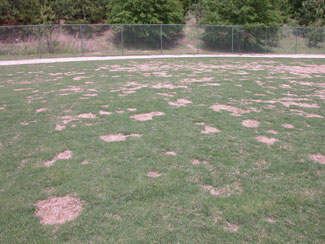
Leaf spot
Resistant Kentucky bluegrass cultivars: Ascot, Princeton 104, eclipse, unique, alpine, SR 2000, bartita, apex, liberty, and barblue Fungicides: Azoxystrobin, chlorothalonil, iprodione, mancozeb, and vinclozolin. Photo: ces.ncsu.edu.
Necrotic ring spot
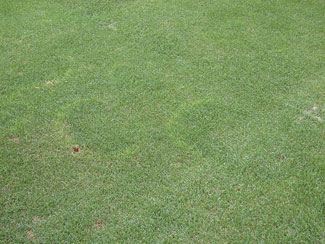
Necrotic ring spot
Pink snow mold
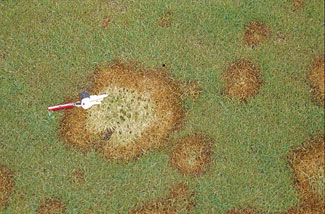
Pink snow mold
Powdery mildew
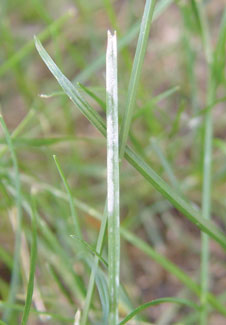
Powdery mildew
Pythium blight
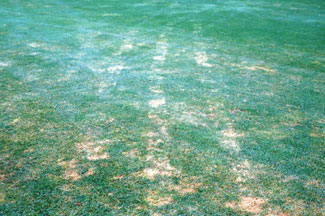
Pythium blight
Red thread
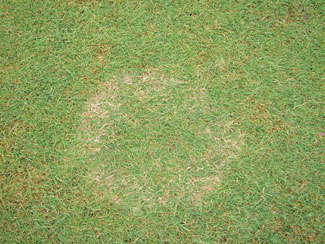
Red thread
Resistant perennial ryegrass cultivars: Regal, legacy, sherwood, derby supreme, loretta, Gettysburg, assure, and pinnacle Fungicides: Azoxystrobin, chlorothalonil, cyproconazole, fenarimol, mancozeb, myclobutanil, propiconazole, thiophanate methyl, triadimefon, and vinclozolin. Photo: cs.osu.edu.


