|
Harmful critters like the Japanese beetle and the gypsy moth were definitely on the Landscape Superintendent?EUR??,,????'?????<
By doing a web search of the words ?EUR??,,????'?????<
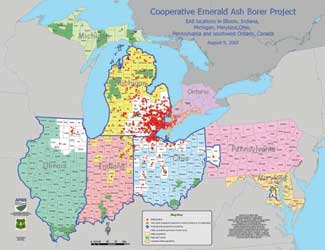
As a result, environmental officials in neighboring states throughout the Midwest have been surveying their ash trees, ready to quarantine counties that show any signs of the pest. With an estimated 30 million trees already killed, more and more states are paying attention. Unfortunately, the expense involved to effectively combat the problem is often too much for small municipalities to handle. Because of this, many experts fear that it will only be a matter of time before the EAB spreads across North America. 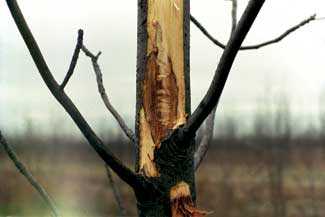 Evidence of the emerald ash borer sometimes takes up to a year to recognize. Pictured is a tree with S-shaped channels found under the tree?EUR??,,????'?????<Photo: invasive.org How They SpreadThe insect can move short distances by flying?EUR??,,????'?????<
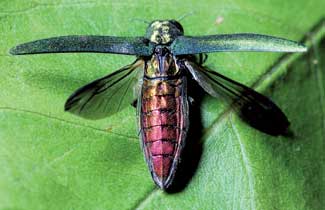
Humans greatly accelerate EAB?EUR??,,????'?????< Adult ash borers are bright metallic green in color, one-third of an inch in length and one sixteenth of an inch wide. They have rounded abdomens and flat backs and are present from mid-May through late July. Their life cycle is estimated to be one year, but may be up to two years in very cold climates. They find coverage in the bark crevices and in foliage during high temperatures and rainy weather. Females lay around 75 eggs from early May to mid-July, which turn to a yellow brown color prior to hatching. Larvae are creamy white, have flattened, segmented bodies and can grow to be an inch long. Difficult to identify because of their color, they feed under bark from mid-summer through spring, which damages the ash tree?EUR??,,????'?????< Evidence of the emerald ash borer sometimes takes up to a year to recognize. The reason the bug kills trees is because it consumes so much bark that the tree cannot get any nutrients up to the top of it. Since the inner core (heartwood) of trees is dead and the inner bark (sapwood) is the living portion of the tree, the bug effectively strangles the tree. What to Look For: Trees in DangerMore than seven billion trees are currently at risk, each facing a slow two to three year death. Emerald ash borers attack all North American ash trees including white, green, and black ash and all horticultural varieties of these trees. All North American ash trees, from the smallest saplings to giant trees, are vulnerable. 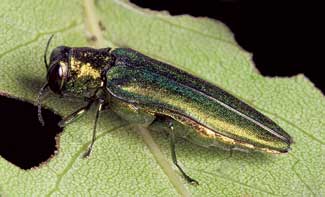 The EAB is changing the face of the tree landscape throughout the midwest. Alternative trees such as Maple, Ginkgo, Kentucky Coffeetree, Oak, and Elm are now being planted to prevent the ash borer spread. Photo: invasive.org Curbing the SpreadTo combat the spread of the borer, the U.S. Department of Agriculture has implemented quarantines in counties where the insect is detected, meaning no trees or firewood can be transported out of the area. In addition, all ash trees within a half-mile radius are destroyed. Companies and facilities that violate these orders are subject to large fines. Wasps to the RescueAccording to The Grand Rapids Press, in July after years of preparation, nearly 1,600 imported Chinese parasitic wasps were released in Michigan counties. Without any natural EBA predators in America, officials were forced to import the wasps, which have kept the pest in check in China. Though only the size of a sesame seed, the stingerless wasps lay eggs in immature ash borers or in ash borer eggs, killing the eggs or larvae before they can become beetles. Baby wasps emerge from their hosts three weeks later, fly off and repeat the cycle. You are probably asking what will be needed to kill the wasps when they become out of control, but scientists are confident their release will not have any unintended ecological impacts.
|