SCAD Atlanta Campus Expansion
Landscape As Urban Framework

The expansion of the Savannah College of Art and Design (SCAD) Atlanta campus illustrates how landscape architecture can function as the spatial, social, and environmental framework of a dense urban campus. Situated in Midtown Atlanta - one of the city's most active cultural districts - the project charged Landscape Architects at national firm LJC to transform a collection of previously disconnected parcels into a 5.5-acre, cohesive academic environment that supports student life, engages the public realm, and reinforces institutional identity within the city.
From Patchwork To Unified
SCAD's Atlanta presence has historically been distributed across multiple buildings embedded in the Midtown fabric. While this arrangement allowed the university's presence to grow incrementally, it lacked the spatial clarity and shared open space typically associated with a campus environment. The expansion strategy addressed this condition directly by consolidating residential, academic, and cultural programs into a vertically organized, mixed-use campus anchored by a network of carefully designed outdoor spaces. In this context, landscape architecture was not conceived as residual space between buildings, but as the connective tissue that unifies program, circulation, and experience across the campus.
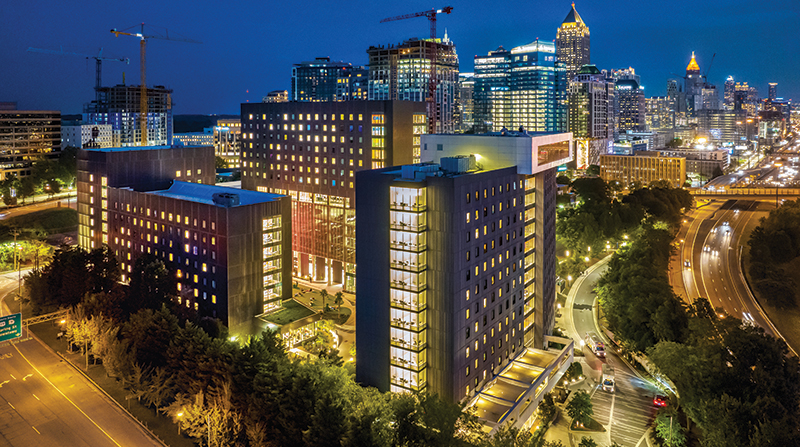
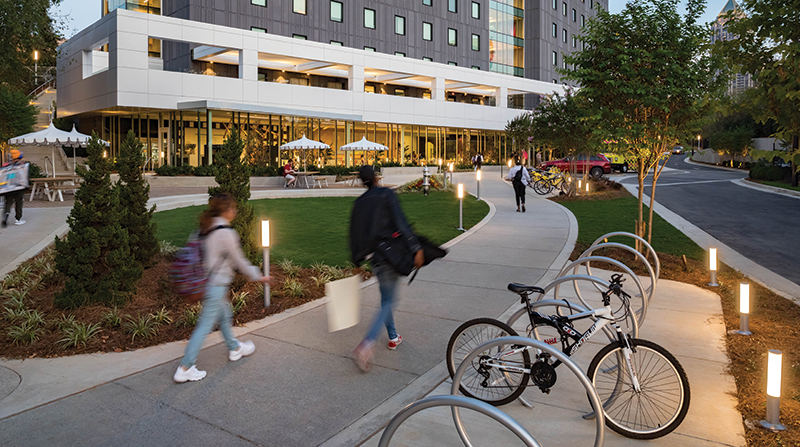
The expanded campus is a dynamic urban presence set against Midtown's iconic skyline. Illuminated towers and vibrant outdoor spaces foster community connections while strengthening the area's identity and its relationship to the surrounding arts district. A green roof, barely visible on the left-hand building, creates an art piece of greenery made possible by 4,448 square feet of a green roof tray system.
The multi-phase development includes several high-rise buildings that accommodate student housing, classrooms, performance venues, retail, wellness facilities, and student amenities. As architectural density increases, the role of landscape becomes more critical at grade and across elevated terraces, where outdoor spaces must simultaneously support circulation, social life, and environmental performance. The landscape strategy responds by prioritizing clarity of movement, flexibility of use, and durability - ensuring that exterior spaces function as essential campus infrastructure rather than mere ornamental additions.
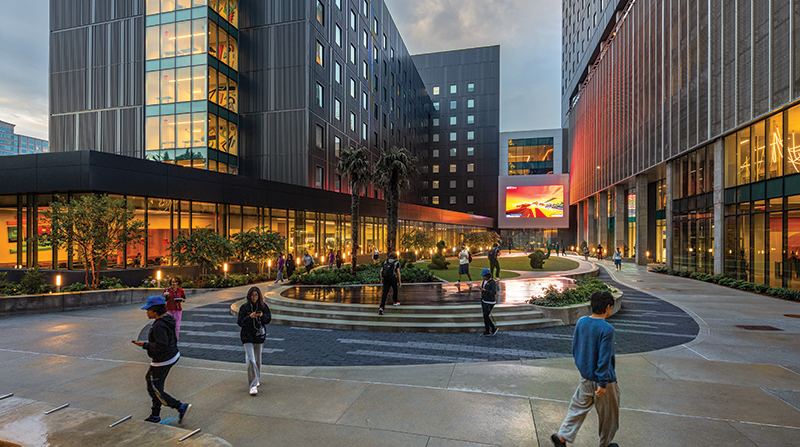
In addition to three Windmill Palms (Trachycarpus fortunei) on the courtyard's center island, a series of Crepe Myrtles (Lagerstroemia 'Gamad V') and Chinese Fringe Trees (Chionanthus virginicus) line the courtyard. Many of the trees found on campus feature a show-stopping seasonal display of pink and white flowers in spring with bright red and orange leaves in fall, providing an annual rotation of colorful inspiration. The project uses 4,635 square feet of concrete unit pavers from Hanover.
The Heart Of It All
At the core of the campus is a central courtyard that serves as the primary organizing element. This space operates as a social condenser, bringing together students from multiple buildings while accommodating a wide range of daily and event-based activities. Its design balances openness and definition through a combination of hardscape, lawn panels, and integrated seating, allowing the space to shift easily between informal gathering, outdoor learning, and large-scale programming. The courtyard's proportions and materiality reinforce a sense of enclosure without isolating it from the surrounding city, positioning it as both an internal campus commons as well as a visible extension of Midtown's public life.
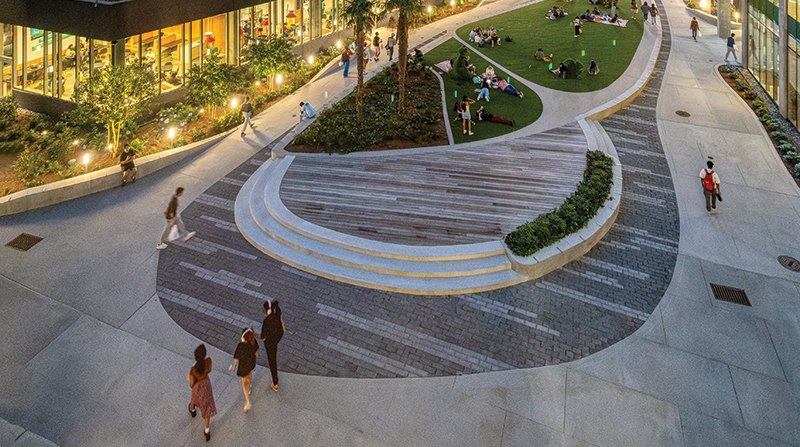
The entire SCAD campus master plan organizes itself around the dynamic hub that is the central courtyard. Offering performance spaces, event experiences, and everyday use, this campus heart is a natural retreat for students, faculty, and visitors. The site contains 2,964 square feet of synthetic turf.
Life On All Fronts
Beyond the central courtyard, a network of pedestrian corridors, terraces, and amenity decks extends the landscape experience throughout the campus. These spaces blur the boundary between interior and exterior environments, supporting study, collaboration, and rest outside of traditional classroom settings. Rooftop landscapes and elevated terraces introduce usable green space into the vertical campus, offering moments of relief from the density of the urban context while maintaining visual and spatial continuity between buildings. These elevated environments are not treated as secondary spaces; rather, they are integral components of the campus's open-space system.
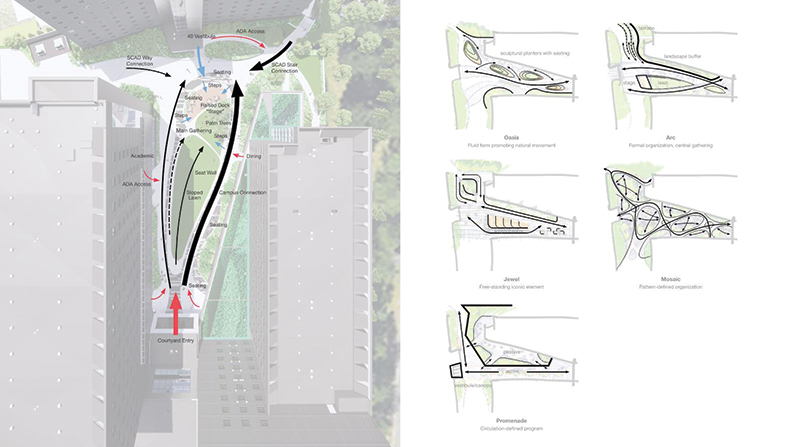
Site circulation and campus programming were examined through multiple lenses, providing unique alternatives and diverse thematic opportunities. The final Arc scheme (left) was chosen over other options (right) because it unified circulation, gathering, and the site's natural grade change into a clear organizing form. Its sweeping geometry frames a flexible lawn and stage with sloped seating and planted edges, all oriented towards a large video screen for events.
The campus's relationship to the public realm is equally intentional. Along Spring Street and adjacent corridors, landscape interventions enhance pedestrian experience through clear circulation patterns, planted buffers, and human-scaled elements that soften the campus edge without compromising safety or visibility. These public-facing spaces support Midtown's role as an arts and cultural district, inviting interaction and reinforcing the idea that the campus is an active participant in the life of the city. The landscape mediates between institutional needs and urban expectations, creating transitions that feel welcoming rather than defensive.
The arrival plaza features a patio terrace, flexible spaces, a drop-off area, parking, and a versatile entry space for food trucks and events. Located on a previously underutilized site constrained by steep, rocky slopes, the three buildings were designed to leverage the grade change as an opportunity to organize the internal program. Stairways lead to terraced landscape areas surrounding the buildings that offer inviting spaces for gathering. Geometric shapes show up in the cone-shaped trees with eye-catching color patterns from the surrounding Variegated Lilyturf (Liriope muscari 'Variegata').
Refining The Palette
Planting design throughout the campus emphasizes resilience, seasonal interest, and long-term performance within a demanding urban environment. Native and adapted species were selected to thrive in constrained soil volumes, high foot traffic, and variable microclimatic conditions. Trees provide shade and scale at grade and on terraces, while layered planting reinforces spatial definition without obstructing sightlines or circulation. The planting strategy supports environmental performance - contributing to heat-island mitigation and stormwater management - while also reinforcing a cohesive visual identity across multiple phases of development.
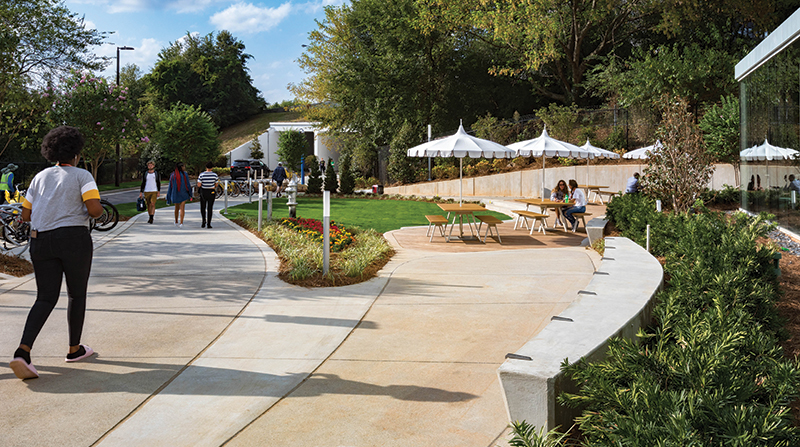
The campus promenade's dynamic paving and lighting enhance wayfinding, linking multi-modal transportation options across the site and connecting to the main academic building via the tunnel. The planting design embraces a refined selection of minimal plant types, with a formal, layered understory, sculpted plant forms, and accent planting at entries. Site furnishings were provided by the owner, with many from Landscape Forms, skateboard deterrents, and security fencing, as well as lighted bollards, uplights, and light columns from Luminis. Colorful annuals are surrounded by Variegated Lilyturf below, while the retaining wall planters are filled with Mahonia (Mahonia eurybracteata 'Soft Caress').
Material selection reflects a deliberate approach to durability and authenticity. Hardscape elements are robust and designed to weather gracefully, acknowledging the realities of heavy use in a student-focused environment. Paving, seating, and site furnishings are integrated into the landscape to support intuitive occupation and movement, reducing the need for added elements while reinforcing a clear hierarchy of spaces. This emphasis on longevity aligns with the campus's long-term operational goals and reduces maintenance demands over time.

The elevated pool deck provides students with a premium wellness space and cityscape views, while a louvered green screen wall and a shade canopy provide relief from the sun, filtering views from the adjacent SCADfit fitness area. The deck is formed by 7,909 square feet of pedestal pavers from Wausau Tile with raised planters in the background.
Form and Function
From a campus-planning perspective, the landscape provides continuity across a complex, phased development. As individual buildings were designed and constructed over multiple years, the landscape framework ensured that each phase contributed to a unified campus identity rather than reading as an isolated project. This continuity allows the campus to evolve over time while maintaining spatial coherence, a critical consideration for large urban institutions operating within tight development footprints.
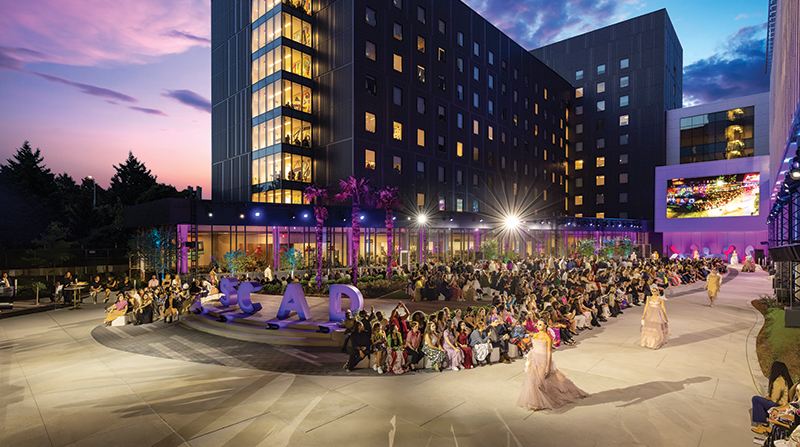
The central courtyard is thoughtfully designed to be a vibrant hub for a diverse range of events and gatherings, including the iconic SCAD Fashion Show, offering an exciting, dynamic space for creative expression and community engagement.
The SCAD Atlanta expansion demonstrates the capacity of landscape architecture to organize complexity - balancing institutional program, student life, and urban engagement within a dense city context. Outdoor spaces are not treated as amenities layered onto architecture, but as essential systems that support learning, social connection, and well-being. The landscape strategy reinforces SCAD's mission as a creative institution, providing environments that encourage interaction, experimentation, and informal exchange.
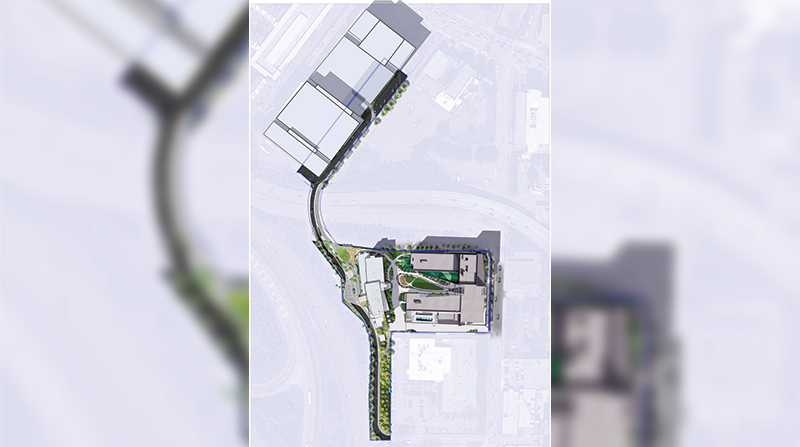
This site plan showcases the SCAD Atlanta Campus transformation, highlighting the three-phase development with interconnected open spaces, three mixed-use towers, and vibrant pedestrian pathways woven into the urban fabric. Previously the site was fragmented, divided by a busy vehicular street and tunnel next to the interstate.
The Perfect Fit
For Midtown Atlanta, the project contributes a series of active, well-designed outdoor spaces that strengthen the district's identity as a cultural and educational hub. The campus engages the city through its ground-level and elevated landscapes, offering spaces that are legible, inviting, and adaptable. In doing so, it demonstrates how institutional development can enhance the public realm rather than retreat from it.
Ultimately, the SCAD Atlanta Campus expansion underscores the evolving role of landscape architecture in contemporary urban campuses. As density increases and programs stack vertically, landscape becomes the element that humanizes scale, supports social life, and provides continuity across time. The project stands as an example of how landscape architecture, when integrated from the outset, can shape not only the spaces between buildings, but the identity and experience of an entire campus within the city.


