The Heights Building
A Transformative Model for Urban Educational Design

The Heights Building is a transformative urban educational campus that exemplifies the power of integrated design-merging architecture, landscape architecture, civil engineering, and community planning into a vibrant, inclusive, and multifunctional environment. Located along Arlington's Rosslyn-Ballston corridor, this 180,000-square-foot facility consolidates the H-B Woodlawn and Eunice Kennedy Shriver Programs into a vertically stacked school serving up to 775 students.
Working in close collaboration with Arlington County Public Schools, BIG and Leo A. Daly on Phase 1 (main building), and VMDO Architects on Phase 2 (parking garage), as well as the Arlington community, Gordon provided comprehensive civil and landscape architecture services across both phases. The project's success hinged on a strategic Use Permit Amendment, which enabled the reconfiguration of the site to accommodate expanded programming, enhanced accessibility, and critical infrastructure improvements-all within a constrained urban footprint.
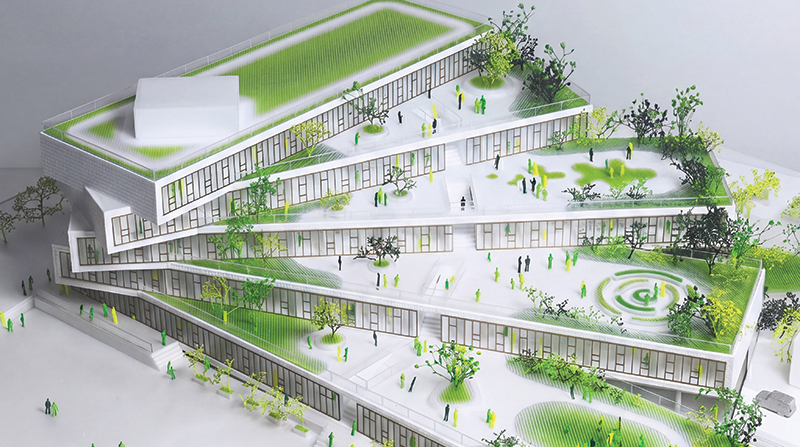
The Heights Building's exterior is made of white glazed brick that unifies the five levels and highlights the oblique levels of the classroom bars. This allows the sculptural form to take center stage, along with the energy and activity of the events occurring inside. The building's material palette pays homage to the historical architecture of Old Town Alexandria.
The building's five rotating floorplates pivot around a central axis, preserving the spatial intimacy of a one-story school while maximizing vertical efficiency. Gordon's landscape architecture team designed green terraces atop each level, transforming them into outdoor classrooms that support quiet study, small group instruction, and large-scale community events. At ground level, an 18,700-square-foot recreation field and universally accessible pathways reinforce the school's commitment to equity and wellness.
The landscape design is expressed through a series of green roof terraces that extend classrooms into the outdoors at each level. These terraces function as immersive learning environments, supporting quiet study, instruction, and informal gatherings while providing access to daylight, fresh air, and vegetation uncommon in dense urban schools. Each of the four primary roof terraces and penthouse roof was designed to reflect the distinct physiographic regions of Virginia, using regionally appropriate landforms, stone, and native plant palettes that interpret the state's geology and topography. Together, the terraces create an educational landscape that reinforces curriculum through direct interaction with place based ecological systems.
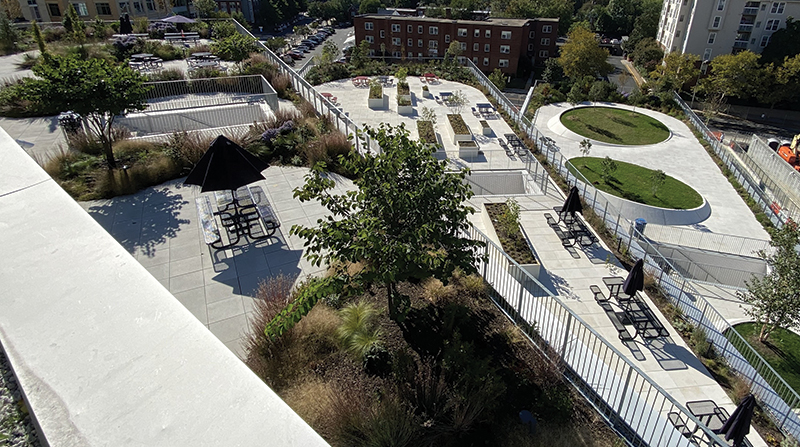
Above each floor is a green terrace that was designed to be an extension of the classroom. Each terrace was designed to reflect the different regions of Virginia, using design elements that distinctly reflect each region. Green planters were placed on each terrace, adding natural color to the Heights' stoic color palette.
At grade, a universally accessible campus framework connects the school to the surrounding neighborhood. A rotating central staircase cuts through the interior of the building to connect the four-tiered terraces, allowing students to circulate outside and forge a stronger bond between the neighborhood and the school. While the upper terraces are more suitable for intimate classes and quiet study areas, the spacious first terrace and recreation field also serve as public event venues for school-wide and neighborhood activities. Pedestrian circulation, enhanced bike infrastructure, secure storage, and outdoor equipment areas promote active transportation, equity, and student wellness.
Easy accessibility to the community-oriented programs hosted in the school encourages public interaction throughout the building, creating a welcoming environment while heightening the visual connectivity between the shared spaces. Includes an art studio, science and robotic labs, music rehearsal rooms, and two performing arts theaters.
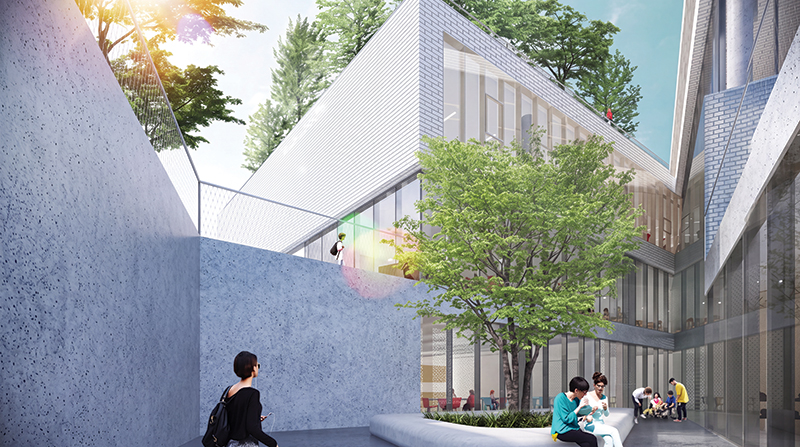
The modern architecture embraces natural light and greenery, creating a vibrant and welcoming learning environment for the students.
From Wilson Boulevard, students, teachers, and staff are greeted by a triple-height lobby with stepped seating that doubles as an indoor gathering space for both student assemblies and public meetings. Many of the school's common spaces, including the 400-seat auditorium, main gymnasium, library, reception, and cafeteria are centrally located and directly adjacent to the lobby.
The classroom bars serve as the primary organizing elements, surrounding a central vertical core that contains the elevators, stairs, and bathrooms. As students enter from the central staircase, they are greeted by an expanded gradient of the color spectrum: each classroom bar is defined by its own color, combining intuitive wayfinding with a vibrant social atmosphere from the ground to the sky.
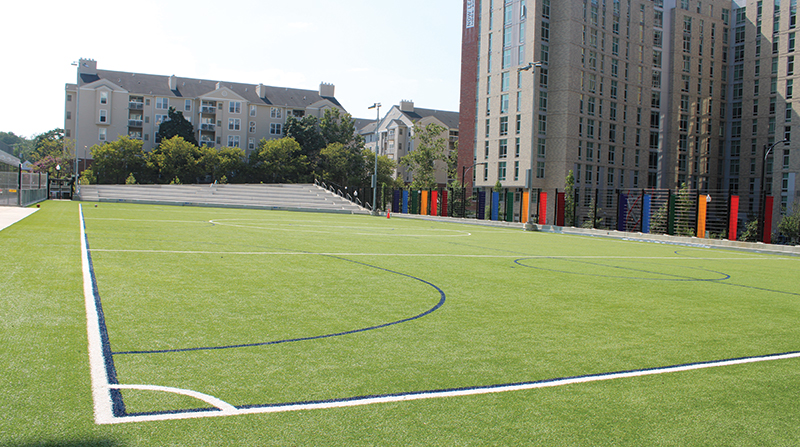
Stepped seating was installed on one end of the outdoor recreation field, transforming it into an outdoor events venue for students and the community alike.
The Eunice Kennedy Shriver Program providing special education for students aged 11 to 22 occupies two floors of the building accessible from the ground floor, and has specialized spaces dedicated to support APS' Functional Life Skills program as well as privacy and ease of accessibility; the gymnasium, courtyard, occupational physical therapy suite, and sensory cottage are designed to aid in sensory processing.
The adjacent 33,000-square-foot Heights Parking Garage showcases a responsive approach to urban infrastructure. Gordon's civil engineering and landscape architecture teams collaborated to design a multi-function rooftop with a lighted multi-purpose synthetic turf field-that serves both school athletics and community recreation. This dual-purpose facility also includes stormwater management systems, enhanced bicycle infrastructure, and outdoor equipment facilities.
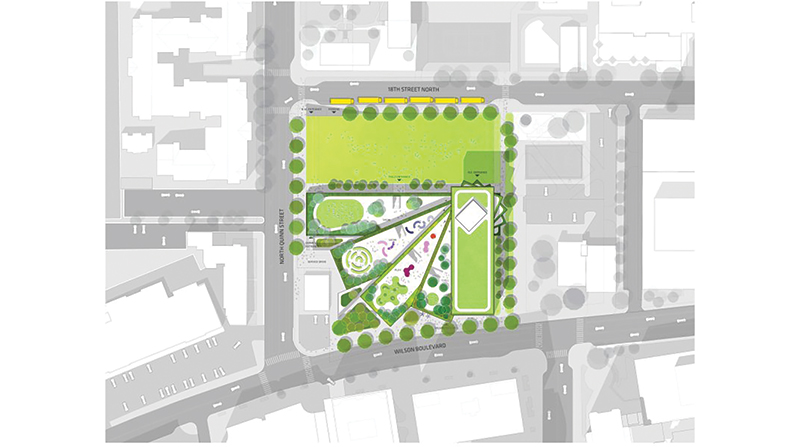
The Heights Building was designed with the surrounding neighborhood and former Wilson school in mind. The goal was to maintain the community feeling and special efficiencies of a one-story school. By situating the building within a compact urban site, with three roads surrounding it (18th Street, Wilson Boulevard, and Quinn Street), the Heights Building brings the community together through its convenient location and methodical design.
Landscape and civil systems were closely coordinated to advance sustainability goals. Stormwater management strategies include on site detention systems designed to retain and release runoff below allowable rates, reducing impacts on municipal infrastructure. A cistern and rainwater harvesting system supports reuse for indoor plumbing and cooling towers, contributing to the project's LEED Gold certification.
Civil engineering played a pivotal role in overcoming site constraints, ensuring ADA compliance, managing stormwater, and integrating utility systems seamlessly into the landscape. The covered, off-street drop-off zone and adjacent handicap parking provide equitable access for all users, while the site's grading and drainage strategies support long-term sustainability and resilience. Additionally, the landscape, in keeping with the rest of the site, was designed using all native plant material, which will enhance the habitat within the urban environment.
The Heights is more than a school-it is a civic landmark where interdisciplinary design elevates educational outcomes, promotes health and recreation, and strengthens community connections.
As seen in LASN magazine, June 2026.


