Lowcountry Celebration Park
Landscape Architecture That Connects, Educates, and Inspires

When the Town of Hilton Head Island in South Carolina set out to create a new community park, the goal was ambitious yet clear: deliver an iconic public space that reflects the island's character and encourages recreation, culture, and community life. The result was Lowcountry Celebration Park, which opened in December of 2020 and has quickly become one of Hilton Head's most beloved gathering places. Located mere steps from Coligny Beach, Lowcountry Celebration Park brings a thoughtfully designed place for people to enjoy. Regional landscape architecture firm Wood+Partners (WP) served as the project's lead consultant, guiding the effort from master planning through construction phase services and coordinating a multidisciplinary team of architects, civil engineers, MEP engineers, and specialty water feature designers. The town's vision, supported through Tax Increment Financing (TIF), was transformed into a destination park that serves residents and visitors of all ages while celebrating the island's natural and historical identity.
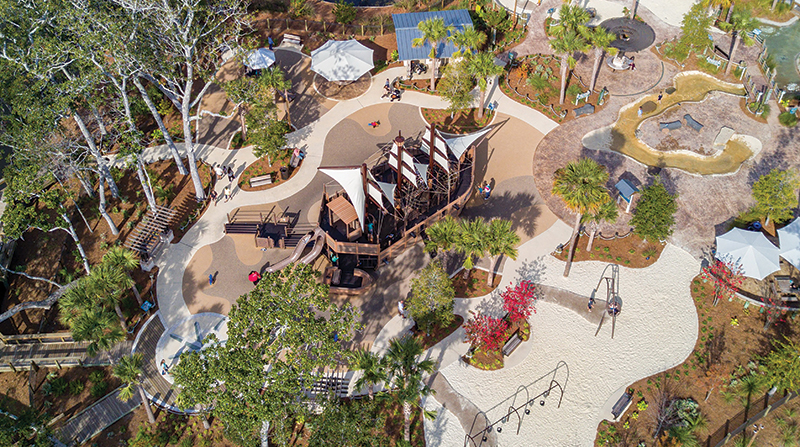
Adventure Playground, furnished completely with Landscape Structures play equipment, features the iconic ship structure and includes a traditional swing set, a multi-user swing platform, Dolphin and Seahorse Whimsy Riders, a sweesaw, a climbing turtle, umbrellas by Shade Systems, Inc., and an area to dig for shells, shark teeth, and crabs. Parents can engage in play or comfortably supervise from nearby ADA picnic tables and benches. PHOTO CREDIT: BEACH PHOTOGRAPHY
Lowcountry-Led Design Approach
WP's approach to the project began with understanding the site's natural and cultural context within Hilton Head Island. The design was intended to work cohesively with the existing area to reveal the character already embedded in the land. Ultimately, Wood+Partners created a landscape framework built around three core principles: (1) Celebrate the island's ecological systems; (2) Create intuitive, accessible circulation and open spaces; (3) Blend history, play, and art into the landscape experience.
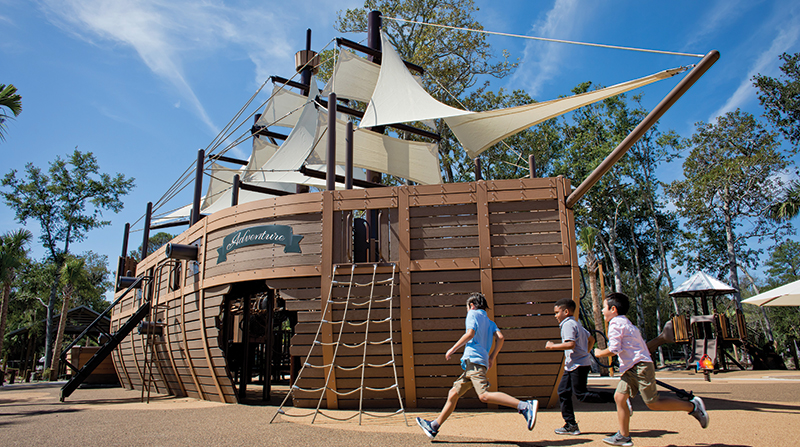
Tying the park to Hilton Head Island's rich history, the ship structure features interactive elements such as tunnels, slides, activity panels, gliders, and misting canons. Play structures not surrounded by sand are anchored in poured-in-place safety surfacing. In the background, a nearby 2-5 playground structure provides opportunities for play under convenient supervision. PHOTO CREDIT: LANDSCAPE STRUCTURES
Master Planning Around Land and Water
The starting point during planning was the site's defining feature: a large, existing stormwater lagoon. Instead of treating the lagoon as a constraint, the Landscape Architects designed the park around it, reshaping the edge, improving hydrology, and integrating it into the recreational network. This body of water became the park's ecological anchor and provided an opportunity to demonstrate how resilient landscape design can address both functional and aesthetic goals.
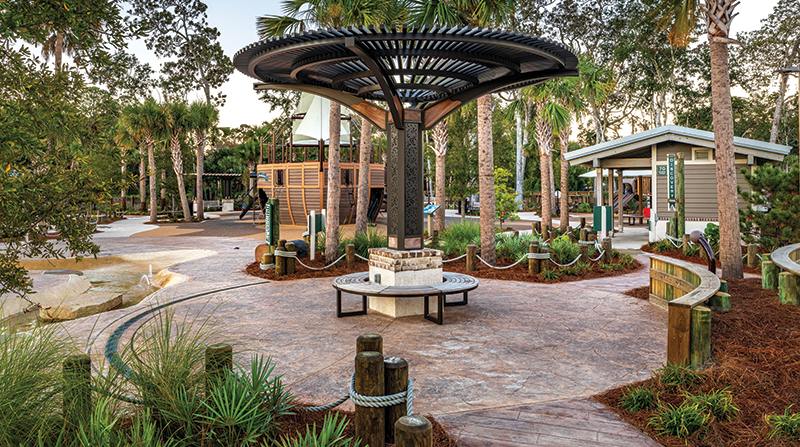
The custom metal arbor tree, designed by the Landscape Architect to be reminiscent of Grand Live Oaks, is surrounded by the Ogden Style circular bench from Maglin. In the background, a restroom facility is paired with human and pet drinking fountains as well as a foot wash for children enjoying the sand play areas. PHOTO CREDIT: NIX CONSTRUCTION
Paths, event lawns, plantings, and play areas were organized around the lagoon's form. The design uses topography, vegetated edges, and unobtrusive lighting to maintain safety while enhancing the lagoon's ecological performance. The master plan also extended pedestrian connectivity throughout the site, linking the park to Coligny Beach, surrounding neighborhoods, commercial corridors, and regional bike pathways. The result is a space that is embedded in the surrounding area while retaining a serene, park-like character.
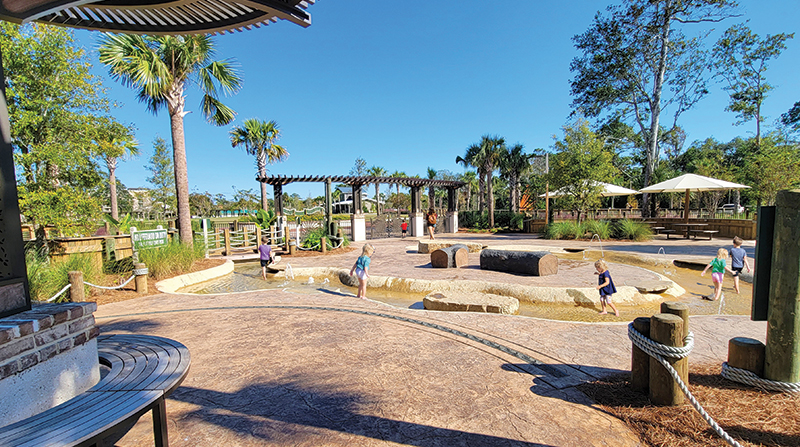
The water feature, complete with fallen tree benches from Cre8Play, creates an ebb and flow that mimics the coastal tides of the Lowcountry. Decorative channel drains are integrated into the circular hardscape design.
A Lowcountry Planting Strategy
The planting design reinforces the ecological identity of Hilton Head Island. Native and adapted species were selected for durability, habitat value, and sensitivity to dynamic coastal conditions. Canopy trees such as Live Oaks (Quercus virginiana) provide shade, while understory species - including Silver Saw Palmettos (Serenoa repens), Wax Myrtles (Morella cerifera), Muhly Grass (Muhlenbergia capillaris), and Weeping Lovegrass (Eragrostis curvula) establish layered textures and seasonal interest. The plantings also serve functional roles: stormwater filtration and bank stabilization near the lagoon, a pollinator habitat and biodiversity enhancement in meadow-like areas, shade and cooling for play zones and gathering spaces, and wayfinding cues along the perimeter walk and central pathways. The vegetation not only strengthens the park's ecological footprint but also expresses the region's unique coastal aesthetic.
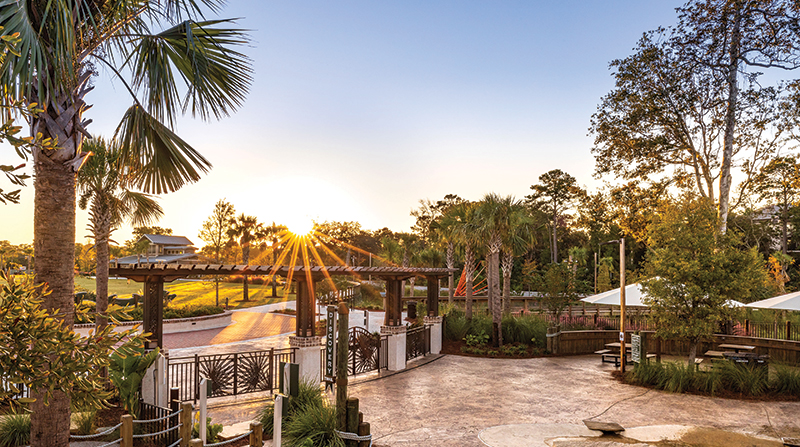
At the Discovery Trail entrance, a custom gate and trellis complement tabby stucco columns with brick caps. The walkway is made of antique rumbled pedestrian pavers in the colors Bluff and Cocoa with permeable vehicular pavers beyond in the appropriately named color "Shrimp Boil." PHOTO CREDIT: NIX CONSTRUCTION
The Adventure Playground
While the iconic play ship draws attention, the surrounding landscape is what shapes the broader play experience. The Adventure Playground is thoughtfully integrated into the park, blending seamlessly with both existing and newly introduced site conditions. The team designed the play environment to feel like an extension of the island's natural systems rather than a separate attraction.
The Discovery Trail, which winds through the playground, uses landscape architecture to teach visitors about Hilton Head's ecosystems. Each play zone interprets a different biome, such as maritime forest, salt marsh, and dune system, through materials, plantings, and sculptural elements. For example, the maritime forest is home to deer, whose habitat is represented by a playground log while an interpretive sign spotlights them and their tracks imprinted in the concrete walkways in the playground. Raccoon tracks are also imprinted in the walks. The ocean/beach is addressed in signage that explains the fragility of nesting sea turtles spotlighted by a climbing turtle. The playground also includes a sand digging area where children search for buried shells and shark teeth. One of the interpretive signs also plays sounds from various fauna, such as tree frogs and osprey.
The interactive water feature integrates water play with environmental interpretation, reinforcing the role of water in shaping the Lowcountry landscape. The Lowcountry of South Carolina is unique in that it includes freshwater wetlands, tidal (saltwater) creeks and rivers, tidal mudflats, and tidal pools found at the beach. The freshwater wetlands are represented in the final design by a pond near the Children's Museum that includes wading birds and turtles. The tidal creeks/rivers transition to the mud flats, where oyster beds are found along with hermit crabs. The beach is represented through an interactive water feature that ebbs and flows like waves on the shore. This combination of ecological education and experiential play demonstrates how landscape architecture can shape meaningful, place-based experiences.
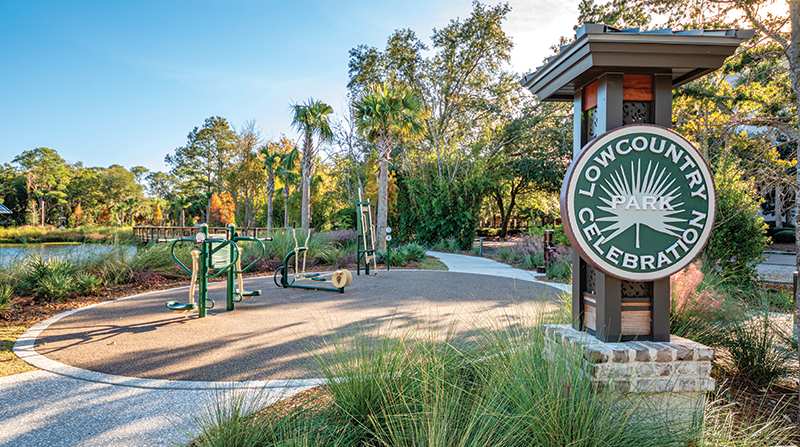
The outdoor fitness station provided by Greenfields Outdoor Fitness located along the walking trail includes a Four-Person Abs & Dip Station, a Two-Person Lat Pull/Vertical Press, a Single Elliptical, a Two-Person Leg Press, and a Stair Climber.
Event and Gathering Spaces
Community gathering was a key objective for the Town of Hilton Head Island, and the Landscape Architects responded with a series of flexible spaces capable of hosting events and festivals. The grand lawn, framed by plantings and connected to a pavilion, acts as the park's central green: an outdoor space large enough for concerts, seasonal events, and informal recreation. Circulation paths are intentionally wide and fluid, allowing crowds to move comfortably during major events while still feeling intimate during everyday use. The lawn's gentle slopes, tree clusters, and sightline management help the space shift between large-scale programming and quieter daily use.
Public art elements - including "Frog On a Bench" by Beau Smith, "Carolina Parakeet" by Todd McGrain, and "Setting Sun" by Tom Holmes - were strategically placed to enrich the spatial sequence, serving as wayfinding anchors and focal points within the landscape. They also provide photo opportunities and memories for visitors.
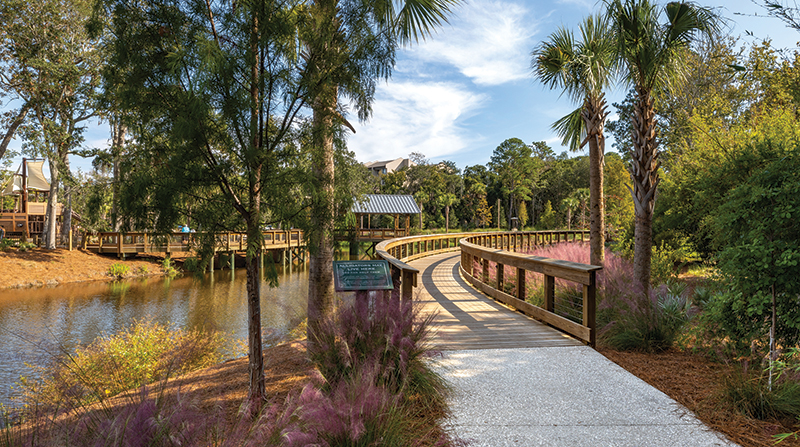
A trail system winds through the park with signage highlighting the island?EUR(TM)s wildlife habitats and their corresponding flora and fauna, like this warning to keep an eye out for alligators. PHOTO CREDIT: NIX CONSTRUCTION
A Walking Experience
The park's perimeter walk - subtly illuminated for evening use - provides one of the site's most compelling landscape experiences. Meandering around the lagoon and linking major destinations, the walkway creates a seamless visitor loop lined with interpretive signage and two outdoor fitness stations. Careful attention to grading, lighting, paving materials, and planting ensures the path remains accessible, visually comfortable, and safe. The loop exemplifies the design team's commitment to designing landscapes that support wellness and encourage year-round use.
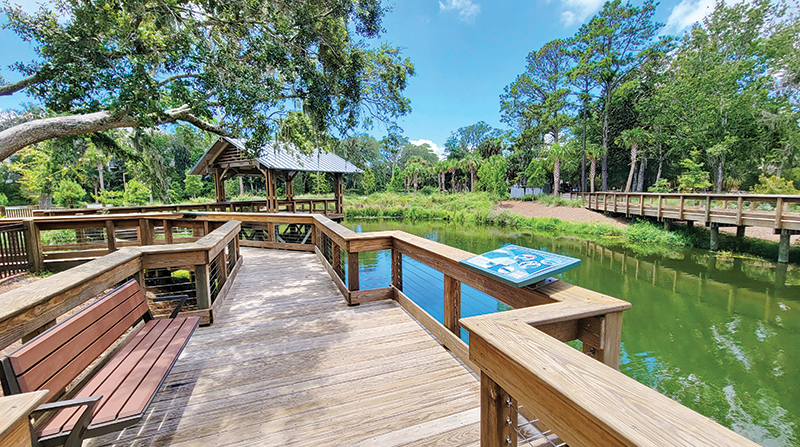
Various boardwalks incorporate the lagoon into the overall park experience, creating cohesive connections across the site. Natural finishes using No. 1 select pressure-treated pine and marine grade wood create a cohesive Lowcountry aesthetic while providing water-resistant durability. Signage here educates visitors about the important functions of stormwater design.
Integrating The Sandbox Children's Museum
Rather than treating The Sandbox Children's Museum as a standalone building, the Landscape Architects positioned it as a landscape-integrated feature. Built along with the rest of the park, the museum nestles into the park's circulation framework, connected by shaded paths, lawns, and play elements. Its presence activates the park daily and reinforces its identity as a hub for family oriented learning.
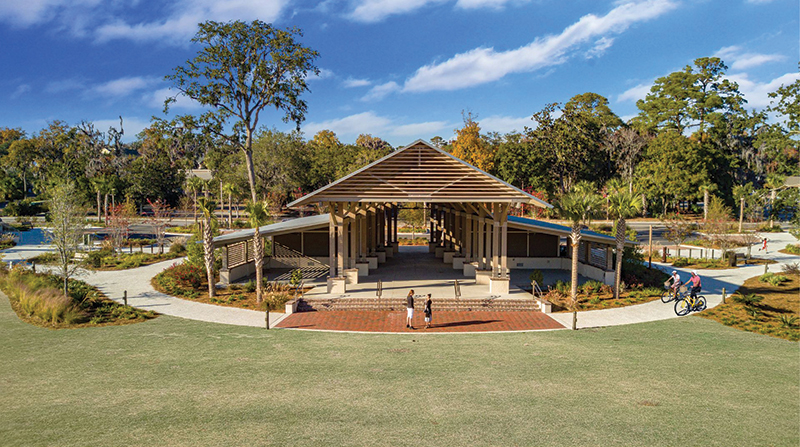
A large green space provides a flexible setting for special events and everyday use, anchored by an open-air pavilion next to the north-end parking lot. Throughout the park, visitors can find bicycle racks as well as bollards illuminating the walking path.
Landscape Architecture as Problem Solving
One of the project's greatest challenges - the stormwater lagoon - became one of its greatest successes. The design team transformed this flood-prone area into a functioning, educational, and aesthetically appealing water feature. They did this by regrading the lagoon to improve storage and circulation, enhancing water quality through planting and edge stabilization, and integrating the water body into the park's artistic and recreational identity.
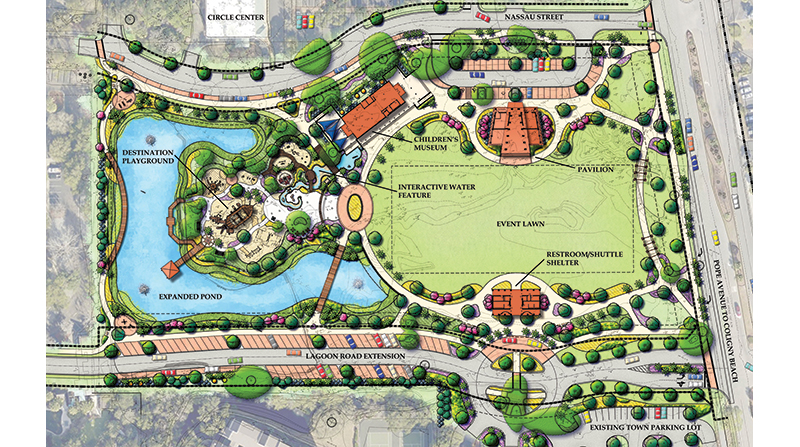
Across the lawn from the open-air pavilion is the restroom and shuttle shelter on the south side entrance. Park activity is divided between the lagoon to the West and the lawn to the East, featuring intertwining trails that connect open spaces for community events with playground structures and gathering areas.
A Park Defined by Its Landscape
Since opening, Lowcountry Celebration Park has been embraced not only as a recreational destination but as a landscape that expresses Hilton Head's ecological and cultural DNA. More than a collection of amenities, it is a coherent landscape system - one that educates, protects, inspires, and supports community life. Through its layered plantings, resilient water management strategies, interpretive design, and thoughtful spatial organization, the park stands as a compelling example of landscape architecture's ability to shape meaningful public spaces.
As seen in LASN magazine, March 2026.


